
Most of us got into bikes by watching someone. It might have been Rossi sliding a Yamaha sideways at Mugello, Marc Marquez saving a front end on his elbow, or Pecco Bagnaia carving a perfect line on the Ducati. Sooner or later you want leathers that look the part. A MotoGP replica leather suit gives you that look, but a good one also has to work as proper riding kit.
This guide is written the way we would explain it to a mate at a track day. It covers what a replica suit actually is, how to choose between one-piece and two-piece, what to look for in the leather and armor, how fit works, and which options are worth paying for.
What a “replica” suit actually is
Let’s be straight about this first. A replica suit is made in the style of a rider’s race leathers. It copies the colours, layout and sponsor-style graphics so it looks like what you see on the grid. It is not the suit the rider wore, and it is not official team merchandise. The real factory suits are one-off pieces built by the riders’ own suppliers, often with airbags and custom sensors, and you can’t buy them off a website.
Our suits are not licensed, made or endorsed by any rider, team, manufacturer or sponsor. If a shop suggests otherwise, ask questions.
What a good replica should give you is a properly built leather suit with the graphics you love. That’s what the rest of this guide is about.
One-piece or two-piece?
People search this question a lot, and the answer depends on how you ride.
One-piece suit
– Best for track days and fast road riding.
– Nothing can separate in a slide, because there’s no join at the waist.
– It feels snug off the bike and comes alive once you’re tucked in.
– It’s harder to get in and out of, and less handy for a coffee stop.
Two-piece suit
– A jacket and trousers joined by a zip around the waist.
– Easier to wear on the road: you can take the jacket off at a stop.
– Zipped together, a good two-piece is accepted at many track days. Check your track or organiser’s rules first, because some events ask for one-piece suits only.
– It’s more flexible if your top and bottom halves are different sizes.
Every suit in our MotoGP collection can be ordered as a 1-piece or 2-piece. You choose on the product page.
Leather: cowhide or kangaroo?
The outer shell does most of the work in a slide, so it matters.
Our standard shell is top-grain cowhide leather, 1.2-1.3 mm. Top-grain is the strong outer layer of the hide. Cowhide in that thickness range is what most road and track leathers are made from: tough, proven and reasonable on cost. It feels firm at first and softens as it breaks in.
Kangaroo leather is available as an upgrade. It’s lighter and more supple for the same protection, which is why many racers choose it. It costs more and needs a bit more care.
We’ve written a full comparison in Kangaroo vs Cowhide Leather for Race Suits. The short version: for most riders doing road miles and the odd track day, cowhide is the sensible choice. If you’re on track a lot and every bit of weight and comfort counts, kangaroo is worth a look.
Armor: what to look for
Leather resists abrasion. Armor deals with impact. A suit needs both.
Our suits come with CE-certified armor (Level 1 and Level 2) at the shoulders, elbows, knees and back, all removable. In plain terms:
- CE-certified means the protectors have been tested to the European standard for motorcycle impact protection.
- Level 1 and Level 2 describe how much impact force gets through. Level 2 lets less through, so it protects more. Level 1 is usually a little thinner and more flexible.
- Removable means you can take the armor out when you clean the suit, and swap or upgrade it later.
On top of the inner armor, our suits have external protection on the shoulders, elbows and knees, plus removable knee sliders. Knee sliders wear out on track, so it’s worth ordering a spare set.
Stretch panels and movement
A race suit that doesn’t let you move is tiring and can be dangerous. When you tuck in on a straight or hang off in a corner, the suit has to stretch where your body bends.
Our suits use stretch Kevlar panels (standard), with an optional Schoeller Keprotec upgrade, at the sleeves, cuffs and crotch, plus expansion panels on the legs. The standard panels do the job well. The Schoeller Keprotec option is there if you want to upgrade.
Look for pre-curved arms and legs too. A suit cut for the riding position will feel a little odd standing in your kitchen and spot-on once you’re on the bike. That’s how it should be.
Construction details that matter
Graphics get the attention, but these smaller things decide how long a suit lasts:
- Stitching: look for double and triple stitching at stress points such as the seat, shoulders and knees. Seams are what fail first in a crash.
- Zippers: they need to be heavy-duty. A main zip that splits is no joke.
- Lining: a mesh lining helps the suit slide on and off and lets air move. A removable lining is handy if you want to wash it.
- Collar and cuffs: neoprene edges are comfortable and stop chafing on long days.
Getting the fit right
Fit is where most people go wrong with leathers. Online, it matters even more.
- Snug, not tight. A new leather suit should feel close-fitting when you stand. It loosens up a bit with wear.
- Armor in the right place. When you’re in the riding position, the knee armor should sit on your knees and the elbow armor on your elbows. If it’s sliding off to the side, the suit is too big.
- Check sleeve and leg length in a tuck. Cuffs should still reach your gloves and the legs should still reach into your boots.
Every suit is made to order. You can choose a standard size (US 36-50, XS-4XL, in men’s or women’s fit) or custom sizing from your measurements. Start with our Size Guide. If you fall between sizes, or your build is a bit unusual (long arms, big calves, tall and slim), go custom. If you’re not sure, message us with your measurements and we’ll help you choose.
For delivery times, see our Shipping Policy. Custom sizes take longer than standard ones.
Options worth thinking about
When you build your suit on the product page, these are the choices:
- Hump: none, standard, ventilated or hydro. A hump helps airflow at speed and looks the part. “Hydro” leaves room for a drinks bladder, which is handy on long track days.
- Perforation: none, chest, front or full suit. If you ride in hot weather, go for perforation. You’ll thank yourself in July.
- Removable lining and extra knee sliders.
- Kangaroo leather upgrade and the Schoeller Keprotec stretch upgrade, as mentioned above.
Picking your rider
This is the fun part. A few favourites from our range:
- Valentino Rossi “Soleluna” 46th birthday suit, in the black, gold and fluorescent-yellow style
- Marc Marquez Ducati 2025
- Francesco Bagnaia Ducati 2025
- Fabio Quartararo Yamaha 2025
- Jorge Martin Aprilia 2025
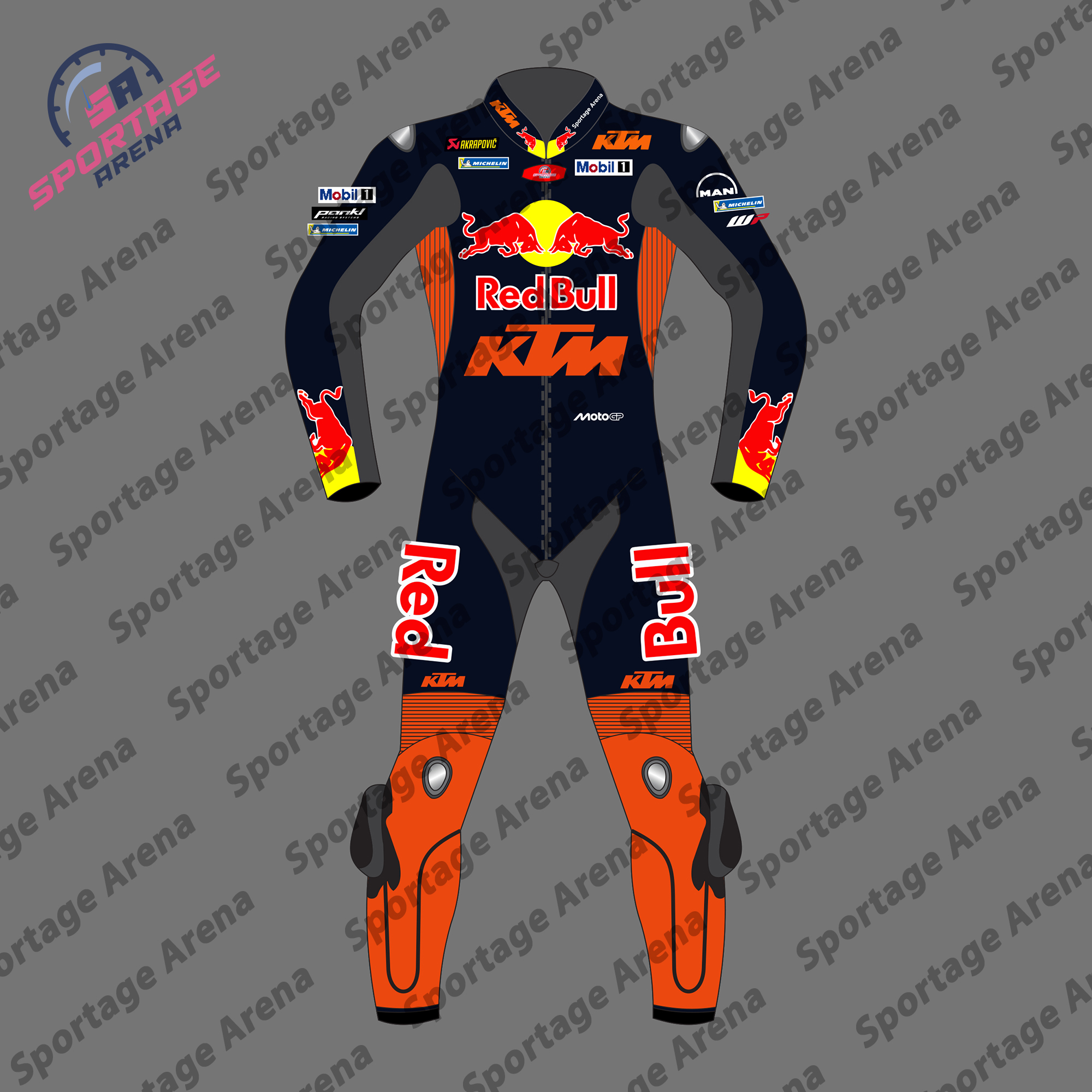
- Pedro Acosta Red Bull KTM 2025
If one rider is your favourite, their page shows every replica we make in one place: Marc Marquez, Jorge Martin, Fabio Quartararo, Pecco Bagnaia, Valentino Rossi and Pedro Acosta.
You can also browse by manufacturer: Ducati, Yamaha, Honda, Aprilia and KTM. If a full suit isn’t what you need, have a look at our MotoGP leather jackets.
Quick checklist before you order
- One-piece for track, two-piece for road (check your track’s rules).
- Cowhide for most riders; kangaroo if you’re on track a lot and want lighter leathers.
- CE-certified armor at the shoulders, elbows, knees and back.
- Stretch panels in the right places, plus pre-curved arms and legs.
- Measure yourself properly. Use the Size Guide, or choose custom sizing.
- Add perforation if you ride somewhere hot, and grab spare knee sliders.
- Be honest with yourself about what “replica” means: the look of your hero, built as a proper suit, not the suit they wore.
Got a question we haven’t covered? Get in touch. We’re riders too, and we’re happy to talk it through before you spend your money.
One thought on “MotoGP Replica Leather Suits: A Buying Guide”